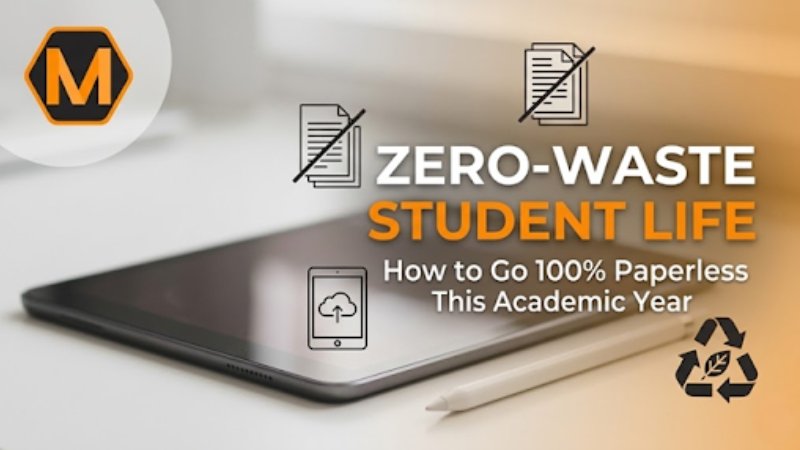
The modern university campus is undergoing a quiet but profound revolution. For decades, the image of the “serious” student was defined by heavy backpacks, overflowing three-ring binders, and the constant, rhythmic hum of library printers. However, as we move through 2026, the “Zero-Waste” movement has shifted from a niche lifestyle choice to a fundamental academic strategy. Going paperless is no longer just about environmental consciousness; it is about building a streamlined, high-efficiency digital ecosystem that allows you to focus on what actually matters: high-level comprehension and mental well-being.
Transitioning to a paperless academic year requires more than just buying a tablet; it requires a complete overhaul of your information workflow. When you eliminate physical clutter, you significantly reduce “cognitive load”—the mental effort required to process and locate information. Instead of digging through a messy folder for a specific handout, a digital student uses indexed search terms to find any document in seconds. This level of organization is especially vital when tackling heavy research subjects; for instance, many students finding themselves overwhelmed by archival research often turn to a reliable history essay writing service like myassignmenthelp to understand how to structure complex chronological arguments without the paper trail.
The Philosophy of the Digital-First Mindset
To successfully go 100% paperless, you must move away from the “print-to-read” habit. Many students feel a false sense of security when they hold a physical piece of paper. In reality, physical paper is a “dead” medium—it cannot be searched, it cannot be easily backed up, and it takes up physical space that contributes to a cluttered mind.
The digital-first mindset treats every piece of information as data. Data can be tagged, linked, and reorganized. When a professor assigns a reading, the paperless student sees a file that can be annotated with a stylus, summarized by AI tools, and stored in a cloud-based directory that is accessible from a laptop, tablet, or smartphone. This accessibility is the cornerstone of modern academic success.
Phase 1: Building Your Digital Tech Stack
A zero-waste academic life is only as strong as the tools you use. You don’t need the most expensive gear, but you do need a “Tech Stack” that talks to each other.
| Component | Recommended Tool | Purpose in a Paperless Workflow |
| Primary Input | Tablet with Stylus (iPad/Surface) | Replicates the tactile memory of handwriting without the waste. |
| Note Architecture | Notion or Obsidian | Acts as a “Second Brain” to link different subjects together. |
| PDF Management | Zotero or Mendeley | Organizes research papers and automates citations/bibliographies. |
| Cloud Storage | Google Drive / OneDrive | Ensures your entire academic history is backed up and searchable. |
| Scanner App | Adobe Scan / Microsoft Lens | Converts rare physical handouts into searchable PDFs immediately. |
Phase 2: Strategic Digital Organization
The secret to staying paperless is a rigid filing hierarchy. Without a physical shelf to guide you, your digital “Desktop” can quickly become a graveyard of “Document1.pdf” files. You should organize your cloud storage using a nested folder system: Year > Semester > Course Code > Week. Within each “Week” folder, you should have three sub-folders:
- Readings: Raw PDFs provided by the professor.
- Notes: Your handwritten or typed synthesis of those readings.
- Assignments: Drafts, peer reviews, and final submissions.
Utilizing Semantic Mapping for Complex Topics
Managing high-level literature reviews and character studies requires a clear mental map rather than a linear list of notes. For example, if you are analyzing classic literature, you might focus on The Ultimate Character Analysis of Mark Antony in Julius Caesar to see how digital mind-mapping can break down complex motivations and rhetorical shifts more effectively than traditional scribbling. By using a digital canvas, you can draw connections between Antony’s funeral oration and modern political rhetoric—links that would be lost on the margins of a printed page.
Phase 3: The “Cognitive Load” Funnel
One of the biggest advantages of a paperless life is how it manages your brain’s processing power. We call this the Cognitive Load Funnel.
The Cognitive Load Funnel for Student Productivity
- Capture (Top): Quickly save every PDF, link, and lecture recording into one digital “Inbox.”
- Filter (Middle): Use OCR (Optical Character Recognition) to find keywords. Delete what isn’t relevant.
- Synthesize (Bottom): Convert filtered data into your own words. This is where true learning happens.
By automating the “Capture” and “Filter” stages with digital tools, you save 80% of your mental energy for the “Synthesize” stage. Physical paper forces you to spend too much time in the “Filter” stage, manually flipping pages and highlighting with ink that can’t be undone.
Phase 4: Maximizing Research Efficiency
When you go paperless, your research capacity expands exponentially. Digital students utilize citation managers to automatically format bibliographies. This removes the “busy work” of academic writing, allowing you to spend more time on critical analysis. By keeping your sources digital, you can use “Find” functions (Ctrl+F) to locate specific keywords across hundreds of peer-reviewed journals simultaneously—a feat that would take a student in a physical library weeks to accomplish.
Moreover, a digital workflow allows for “Intertextuality.” You can have your textbook open on one half of the screen and your note-taking app on the other. You can drag and drop diagrams directly into your notes, ensuring that your study guides are visually rich and easy to review.
The 2026 Sustainability Standard
Beyond the personal benefits, the zero-waste student life is a commitment to global citizenship. The environmental cost of paper production—from massive water consumption to deforestation—is a burden the modern student no longer needs to carry. By adopting a digital-first mindset, you are participating in a circular economy where information is shared, edited, and stored with a near-zero carbon footprint.
The Environmental Impact Table (Per Student/Year)
| Resource | Traditional Student | Paperless Student | Savings |
| Paper Used | ~10,000 sheets | 0 sheets | 100% |
| Water Consumption | ~50,000 Gallons (Production) | ~50 Gallons (Tech Charging) | 99.9% |
| Carbon Footprint | High (Transport/Waste) | Low (Digital Storage) | ~85% |
Phase 5: Overcoming “Digital Fatigue”
A common argument against going paperless is “screen fatigue.” To counter this, successful digital students employ Energy Mapping. * High Energy (Morning): Use your laptop for deep-focus writing and data analysis.
- Medium Energy (Afternoon): Use your tablet and stylus for active note-taking during lectures.
- Low Energy (Evening): Use an e-ink device (like a Kindle or Remarkable) for “passive” reading. E-ink doesn’t emit blue light, meaning it won’t ruin your sleep cycle, yet it keeps you within your zero-waste ecosystem.
The Role of Professional Academic Support
Even with the most sophisticated digital tools, the sheer volume of college assignments can occasionally become a bottleneck. The transition to a paperless year is about efficiency, and sometimes efficiency means knowing when to delegate. Whether you are struggling with a complex data science project or a nuanced literary critique, seeking professional academic guidance is a smart way to maintain your workflow.
Expert consultants can provide the structural frameworks and research insights that help you keep your digital library organized and your GPA high. These services act as a “Value Bridge”—helping you move from the overwhelming phase of data collection to the polished phase of final submission. This is particularly useful for graduate students who are managing thousands of digital sources for a single dissertation.
Final Thoughts: A Smarter Way to Study
Going 100% paperless is a journey of a thousand clicks. It starts with the decision to stop printing syllabi and ends with a sophisticated, searchable, and sustainable academic history that you can carry in your pocket. As you navigate this academic year, remember that the tools are there to serve you, not the other way around.
By leveraging digital organization, professional support, and a minimalist mindset, you aren’t just saving paper—you are mastering the future of education. You are transitioning from a passive consumer of information to an active architect of knowledge. In 2026, the most successful students won’t be the ones with the thickest notebooks, but the ones with the most efficient digital workflows.
About The Author
Mark is a dedicated content strategist and academic consultant specializing in high-level research frameworks and digital education trends. With a focus on bridging the gap between complex curriculum requirements and student success, Mark contributes expert insights to the MyAssignmentHelp platform, helping scholars navigate the evolving landscape of modern academia with precision and clarity.